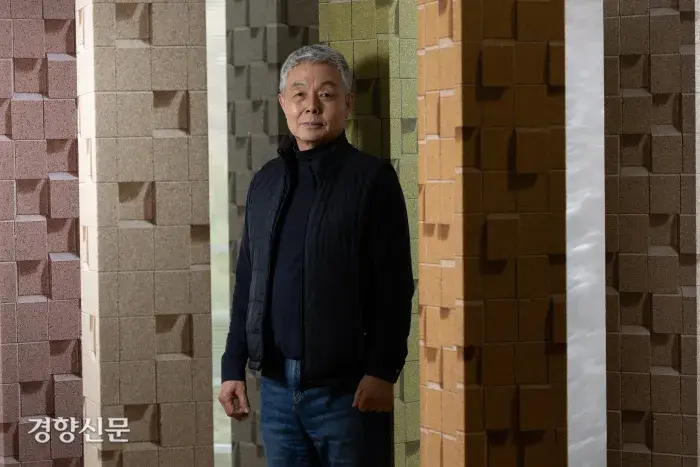
On April 5th, I drove to Hwanggeum-ri, Yangpyeong, Gyeonggi Province. Two white two-story buildings stand serenely on a 200-pyeong (approximately 661 square meters) plot of land atop a beautiful lawn. The upper building houses the studio of Kim Kang-yong (72, Western painter), while the lower building houses the studio and home of his wife, Kim In-ok (67, Eastern painter). Fish leisurely play in a small pond nestled among the trees.
Artist Kim Kang-yong is renowned as a "brick painter." He has dedicated himself to painting bricks for over 40 years. He has gained international acclaim for his works, which utilize sieved sand, applied as adhesive, thinly spread on canvas, then shading with a brush to create optical illusions that mimic real bricks. All the bricks in his paintings are virtual, illusory. Kim stated, "I'm exploring the essential question of visual art: 'What does it mean to see?'"
Having based himself in New York for ten years since 2004, he has traveled extensively between Korea, the US, and China. This year, he's taking on another challenge. He said, "This summer or fall, I plan to temporarily suspend my life in Korea and set up a studio in Europe, perhaps in Berlin, to work there."
We are exploring the essential question of visual art: ‘What does it mean to see?’
-Why is it a brick?
"In the 1970s, when I was in college, there were frequent student protests against the Yushin regime and labor demonstrations demanding improved working conditions amidst rapid industrialization. The Park Chung-hee regime was oppressive. I wanted to reflect that era in my work. When I painted grass, I delicately depicted each blade of grass. I wanted to convey the message that every blade of grass is precious. Grass is a metaphor for people, for human dignity. For the same reason, I painted bricks. At the time, the entire country was a construction site, and each grain of sand became a brick, and bricks became a building."
-Do you still convey the same message in your work?
"No. For a long time, the essential question of visual art—'What does it mean to see?'—has been a pervasive theme in my work. I don't paint bricks. I just paint shadows. Yet, when viewers see my work, they perceive it as bricks. That's because they have the image of a brick in their minds."
In fact, his early brick paintings were figurative, replicating bricks as they appeared. In the 2000s, he adopted a new technique: applying sand to canvas and then drawing the shadows of bricks. Rather than depicting the actual bricks themselves, he painted the images of bricks he envisioned in his mind. He has experimented with transcending the boundaries between abstraction and figuration, expanding two-dimensional paintings into three dimensions. Another hallmark of his work is his "multi-point focus." Within the same work, the bricks appear differently when viewed from the left, center, and right through shadows.
-It's amazing how the shadows alone create an optical illusion that makes it look like real bricks are attached.
"Leonardo da Vinci's 'Mona Lisa' is ultimately a work of shadow drawing. By drawing the protruding parts brightly and the sunken parts darkly, the three-dimensional effect is enhanced, making the figure appear more like a real person."
-The sand used in your work is incredibly diverse, with red, yellow, blue, and black. Are these really the colors of the sand, unmixed with any paint?
"It's a natural material, uncolored. The color, thickness, and texture of sand varies from region to region, even from country to country—the West Coast, the East Coast, Jeju Island. We finely grind and mix different colored sands to create a third color. These days, we also mix in silica sand, a transparent, colorful material made from ground marble and other materials."
He uses the technique of inlaying sand, which is spread thinly on a canvas with adhesive, then chiseled into the sand and replaced with sand of different colors, thicknesses, and textures.
-How often do you go out to collect sand?
"I usually go out once or twice a month, but sometimes I only go out once every three or four months. I enjoy driving and traveling. My wife and I sometimes go for a day trip to collect sand, or we take a circuitous route from Mokpo to Busan to Gangneung. I don't collect a lot at once. I bring it back little by little. I think going out every now and then when I'm not drawing well helps me paint better. I changed my car two years ago, and my previous car had been driven 300,000 kilometers over seven or eight years. That's how much I've been collecting sand."
-Since you've been collecting it for decades, you should be able to tell which region the sand comes from just by looking at it.
“That’s right. I can tell at a glance whether it’s Samcheonpo sand or Gyeongpodae sand (laughs).”
-How much time do you spend drawing a day?
"I'd say it's everything except for when I eat or sleep. I wake up around 7 or 8 a.m. and go to bed around 1 a.m., and I just draw all day long. There are times when I'm working without even noticing the sun rising."
-Aren't you bored of doing the same thing over and over again all day?
"Not at all. Even sleeping and resting are all for the purpose of drawing. I think the joy of immersion keeps me drawing. I'm a person with a wide range of interests. I'll do well at anything I start. But I don't. I don't want to waste time drawing. I don't drink or smoke. The only thing I enjoy besides drawing is watching the Premier League, often late into the night."
-Do you have a special routine when working on a drawing?
"The first thing I do when I come up to my studio is turn on the TV. Until 20 years ago, I used to work with classical music on, but at some point, I started working with the TV on. I usually put on travel programs, but I don't watch or listen to them. I just feel them as everyday noises as I work."
Kim was born in 1950, the son of a farmer, in the Eonyang Kim clan village of Deokcheon-myeon, Jeongeup-si, Jeollabuk-do. He is the eldest of eight siblings. Although born to war, he has no memories of the war. He reportedly heard that the eldest family member was taken away by the North Korean army during the Korean War, and several villagers lost their lives. His earliest memory from when he was three or four years old is that he loved to draw. As an elementary school student, he copied Kim Jong-rae's "Thirty Thousand Miles in Search of Mother" (1958) and Kim San-ho's "Lai-Pai" (1959).
-You showed talent from a young age.
"But my father absolutely hated my drawing. He even turned off the lights at night to stop me from drawing. I still remember drawing secretly by the lamplight while he was asleep."
-But how did you become a painter?
"It was all thanks to my third-grade homeroom teacher, Choi Jae-nam. During art class, he looked at a drawing I'd made and said, 'You're really good at drawing,' and gave me a big compliment. That one word shocked me. It was the first compliment I'd ever heard. That's when I decided: I'd spend my life drawing, becoming an artist."
-How did you persuade your father?
"I went to Baeyoung Middle School, a town located just over a mountain from where I went to middle school. When I was a freshman, my art teacher, Na Byung-jun, was so surprised by my drawings that he invited me to join his art class. I loved it. My idol, Jeon Su-cheon (a renowned Korean installation artist who passed away in 2018 and won a special award at the 46th Venice Biennale), was the class president in my third year. I was incredibly active in the art class. My teacher suggested I go to Seoul to study art. When my father strongly opposed it, he came to my house on his bicycle."
-What did you say to persuade him?
"Kang Yong-i wasn't an ordinary kid. He had to draw (laughs). So his father sent him to Seoul to study. At my teacher's recommendation, I was accepted as second in my class to Seorabeol High School, an affiliate of Seorabeol Arts College. I think my teacher probably didn't even know about Seoul Arts High School at the time (laughs)."
After a year of preparation, he entered the Department of Western Painting at Hongik University in 1971. His advisor was Park Seo-bo (91), a master of monochrome painting. He returned to school in 1976 after completing three years of military service and presented his first, signature brick painting, "Reality + Image," that same year. In 1979, he became the first hyperrealist to receive a special prize at the National Art Exhibition of Korea. Bricks, expressed in sand, began to appear in his work in earnest in the 1980s.
-What memories do you have of Master Park Seo-bo?
"He was very strict. Looking back now, just having someone like him around was an education in itself. I benefited greatly. He invited me, a recent graduate, to participate in the 'Ecole de Seoul' (regular group exhibition) led by Professor Park Seo-bo. He said, 'Your work is good. Let's work together.' It was a group exhibition featuring some of Korea's most renowned painters."
-Before that, in 1978, the year of his graduation, he formed a group called ‘Reality and Reality’, a group with a hyper-realistic painting trend, with his Hongik University classmates Kwon Su-an, Kim Yong-jin, Seo Jeong-chan, Song Yun-hee, Jo Deok-ho, Joo Tae-seok, and Ji Seok-cheol, and published works.
"At the time, abstract painting was the trend in the Korean art world. Realism, which sought to accurately reproduce objects as they were, was disparaged as cliche art, the work of people of inferior skill. But at the time, abstract painting didn't resonate with people like me. Even in those days, when overseas travel wasn't free, Park Seo-bo, who was active internationally, explained to us that hyperrealism was the trend in the global art movement. He even brought us art magazines. It was a huge help. He contributed significantly to the development of Korean art."
-You received your master's degree from Hongik University Graduate School in 1981 and got married that same year. How did you meet your wife?
"Before I enlisted, I taught college students in my studio. My classmate Jeong Deok-yeong also worked part-time, and my wife was one of his students. When I returned to school, I found him in Hongik University's Oriental Painting Department. As a wife, I saw him in the studio, so I called him "Ajusshi" (uncle), "Ajusshi" (uncle), "Sunbaenim" (senior), and then "Honey" (you) (laughs)."
Artist Kim taught at Hongik University Middle School for five years, starting in 1980. He needed a stable living to get married. The Chun Doo-hwan regime's ban on foreigners meant he had no other option. Five years later, his wife took over as art teacher, and for a while, he focused on his art. He first gained international attention in 1999 when his works sold out at the Cologne Art Fair, becoming so popular that they were all sold out. He then participated in international art fairs like the Basel Art Fair, the Chicago Art Fair, and the Tokyo Contemporary Art Fair, further enhancing Korea's standing.
-You settled in New York, USA, and worked there for 10 years, starting in 2004. Why did you go to New York?
"There were two reasons. When the Hongik University Graduate School of Fine Arts was established in 1999, I became a full-time professor. However, I had very little time to paint because I was busy supervising students' theses. Also, I signed a ten-year contract with Park Ryu Sook Gallery in 1999 to support my international activities, but it was too open for me. I wanted to break free from the constraints. The deal went well, so I terminated the contract, and in 2005, without speaking a word of English, I boarded a plane to New York."
-Did you go alone?
"Yes, I did. I set up a studio in an officetel in Dumbo, a Brooklyn neighborhood between the Manhattan and Brooklyn Bridges. Dumbo is a neighborhood with a cluster of galleries and artist studios, and a Korean sponsor provided the space."
In 2006, he was invited to exhibit at the New Hope Gallery in New York. A prominent Korean gallerist visited the exhibition and purchased his work, which led to an exhibition in Seoul two years later in 2008. In 2009, he was invited to the Beijing "China Art Museum" and the Beijing T Art Center, a commercial gallery, attracting attention in the Chinese market.
-How long have you been in Dumbo?
“After three or four years, I moved to West New York, just across the Hudson River, where the rent was a bit more expensive. My paintings were selling well.”
-What kind of inspiration did you get from New York?
"Manhattan is a jungle of buildings, and at first glance, they're all made of brick. But the bricks are all different colors. I used to see them every day, and I found inspiration from those visits. For over 20 years, I'd worked exclusively in monotone. I'd only varied the tone, thickness, and texture of sand-colored work, but I'd never even considered changing the color. It was in New York, experiencing color, that I began painting colored bricks. I collected my color works and held a large-scale exhibition at the Gana Art Center in 2008."
While painting in my New York studio, I frequently visited the Museum of Modern Art, the Guggenheim Museum, and the Whitney Museum of American Art. An exhibition at the Guggenheim became my goal. The only Korean artists to have rented the entire Guggenheim for an exhibition were Nam June Paik in 2000 and Lee Ufan in 2011. This feat was only possible with financial backing.
Why did you open your studio and gallery, "With Space," in the "798 Art Zone," China's largest art gallery district in Dashanzi, northeastern Beijing? It opened on August 8, 2008, the same day as the Beijing Olympics opening ceremony.
"My second daughter went to study abroad in China when she was in high school. Since China was developing, my wife said she would work there and take care of our child. I lived in New York and traveled back and forth between Korea and China. My wife was upset that she didn't have time to paint because the gallery was doing so well (laughs). When my daughter finished school, I closed the gallery in the summer of 2014. Around the same time, I also ended my life in New York, sold my house in Seoul, and settled down in Yangpyeong, Gyeonggi Province, where I had built a house in 1990, in 2015."
-My two daughters also do art.
“The eldest son, Jae-won (40), graduated from Hongik University’s Department of Western Painting and is currently working as a painter. The second son, Jae-young (32), majored in Chinese language and literature at Tsinghua University and is currently majoring in art history at Hongik University’s graduate school.”
-Have you given up on your goal of exhibiting at the Guggenheim in New York?
“That’s not possible. That’s every writer’s hope (laughs).”
In the summer of 2020, he held a large-scale retrospective exhibition titled "Korean Veteran Artists Invitational Exhibition - Kim Kang-yong: Hyperrealistic Bricks" at the Sungkok Art Museum. It featured approximately 160 works, ranging from his early works to his most recent. This exhibition sparked inquiries from galleries in Switzerland and New York, USA, regarding exhibition invitations and residency programs. A museum in Amsterdam, Netherlands, also expressed interest in inviting him. However, due to the worsening COVID-19 situation, the exhibition was temporarily put on hold.
-What are your plans for the future?
"I had planned to set up a studio in Berlin, Germany, and base my activities there, but the COVID-19 pandemic prevented me from doing so. Now that the pandemic is subsiding, I plan to set up a studio and travel to Europe this summer or fall."
"As long as my health permits, I will continue painting until the day I die," he said. "Because it's fun." For this aging artist, who continues to challenge himself even past his 70s, age is just a number.
by. Ju Yeon Park / https://www.khan.co.kr/article/202204100755001